
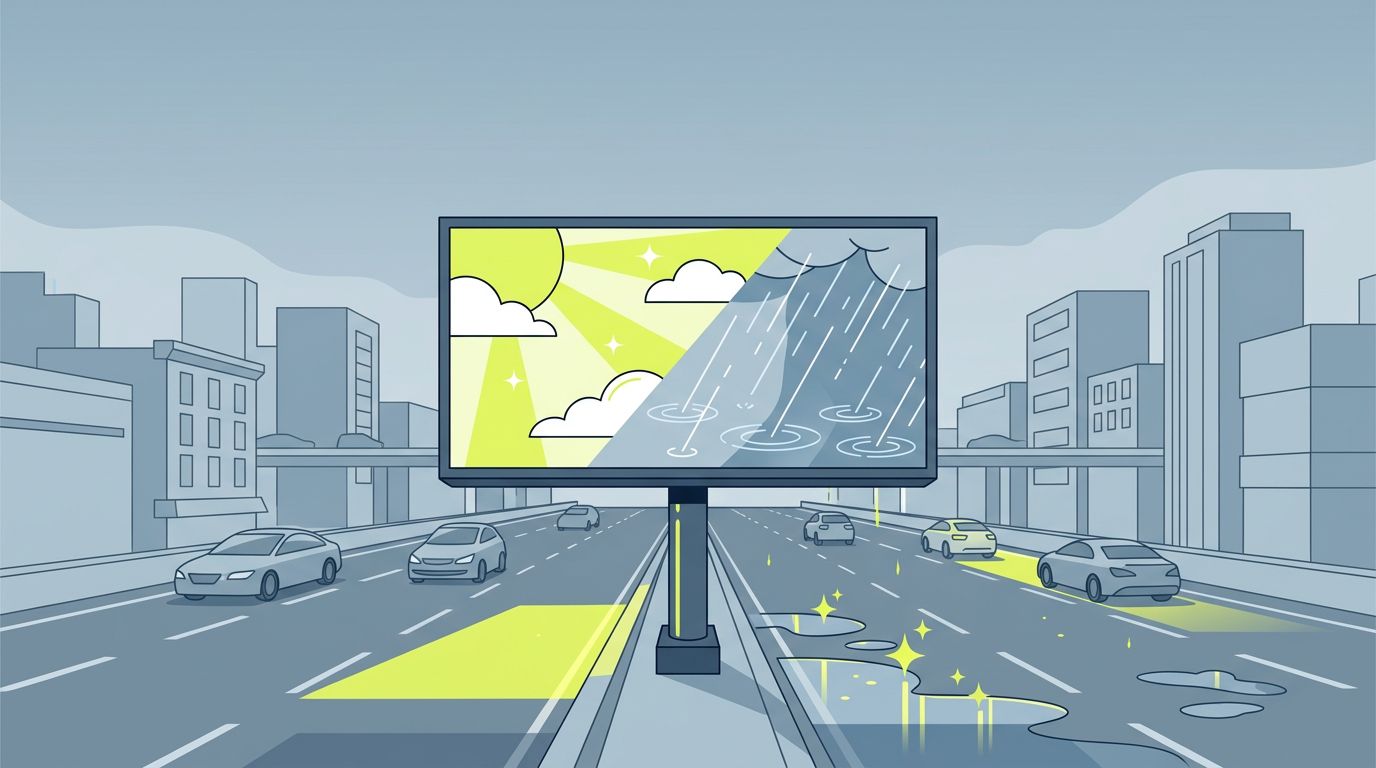
A billboard has only a few seconds to earn attention, and that constraint can produce some of the sharpest advertising work around. For marketing leaders focused on trackable digital channels, outdoor advertising can feel hard to justify, yet a well-placed board builds consistent brand awareness in the real world. These ads occupy the public space where people commute, shop, and make decisions.
The strongest out-of-home advertising does not try to say everything. Instead, the best billboards pair a clear message with a visual idea people can grasp at highway speed.
Key Takeaways
- Design for Instant Recognition: Billboards reach audiences at high speeds, so effective creative must focus on a single, clear visual idea that can be decoded in seconds.
- Location Is a Real Estate Strategy: Outdoor advertising functions primarily as a brand awareness tool rather than a direct-response channel; prioritize high-traffic placements to build long-term local familiarity.
- Digital Flexibility Drives Engagement: Digital out-of-home (DOOH) technology allows brands to rotate messaging and react to real-world variables, such as weather conditions, to keep campaigns fresh and relevant.
- Measure Long-Term Impact: Unlike digital performance ads, outdoor media builds the top-of-funnel recognition that puts a brand into a customer’s consideration set before they are ready to purchase.
Billboards Are a Real Estate Buy, Not a Traffic Guarantee
Outdoor advertising is, in many ways, a real estate purchase. Location, visibility, traffic flow, nearby landmarks, and inventory in a given market all affect price. A board along a major Atlanta highway carries a different cost and value than one on a quieter surface street.
Media sellers often frame a buy around the number of vehicles that pass a board. These impressions are factually based on traffic counts, but they do not mean every driver read, remembered, or acted on the message. A target audience moving at 70 or 90 miles per hour has limited time to notice the board, process the idea, and connect it to the brand.
That reality should shape both buying decisions and creative expectations. OOH works best as a broad awareness tool, especially when a brand needs to stay familiar in a specific market over time.
A billboard does not need to close the sale on the roadside. It needs to earn a place in the buyer’s memory before the buying moment arrives.
Design for a glance, not a close read
The death-metal-logo comparison makes the point well. An intricate visual identity might suit a concert poster, but it is a poor fit for a board viewed through a windshield. If the name, message, or visual takes too long to decode, the opportunity is gone.
There are exceptions. Mailchimp once used a death-metal-style wordmark on an Atlanta billboard near the Downtown Connector. It made drivers pause for a beat to figure out what they were seeing. That brief moment of effort worked because the idea was intentional, surprising, and still recognizable once the viewer solved it.
For most advertising media, clarity wins. Large type, a focused visual, and a short line give people the best chance to retain the message.
Digital Billboards Give Traditional Media More Range
Traditional boards are large vinyl banners installed on a structure for a defined period. They can be visually striking, but production and installation add cost, and the brand is committed to one location for the duration of the buy.
Digital billboards changed the equation. Instead of owning one face for several weeks, advertisers can buy a rotating placement that appears for short intervals, often alongside several other advertisers. This style of digital out-of-home advertising lets a campaign appear across several parts of a city without the cost of a full static buy in each location. Providers like Clear Channel Outdoor have helped standardize these networks, making it easier for brands to manage widespread placements.
Earlier mechanical boards tried to create rotation with triangular panels that flipped between ads. Those formats often created visible gaps between panels, and their moving parts could fail. Digital displays replaced that clunky experience with cleaner transitions and far more control over the creative.
For a Graphic Design & Advertising Agency, that control opens room for a campaign to react to the conditions around it rather than repeating one fixed message.
A weather-triggered campaign for Ruud
A Ruud HVAC campaign showed how DOOH can respond to real life. The creative tied these digital billboards to the current temperature in Atlanta and Charlotte. As the heat increased, the message changed with it.
At 90 degrees, lines such as “Even your sweat is sweating” made the uncomfortable weather part of the joke. Other messages pushed the idea further, describing heat intense enough to make people think about air conditioning. During cold weather, the campaign flipped the concept with lines such as “Someone please spill coffee on me cold” and “Cows are making ice cream cold.”
The message changed, but the brand system stayed consistent. That balance matters. Viewers got a fresh reason to notice the board while still recognizing who was speaking.
Chick-fil-A Shows What an Outdoor Idea Can Become
Chick-fil-A’s “Eat Mor Chikin” cows are among the best-known examples of an advertising campaign because they used the structure of the billboard as part of the joke. Cows climbed poles, hung over the edge, and appeared to paint the boards themselves. These large-format executions turned a basic media placement into something drivers could not miss, providing a much higher impact than smaller forms of outdoor advertising like street furniture.
The copy stayed simple. Misspelled words, backward letters, and the cows’ point of view gave the campaign a distinct voice without requiring much explanation. Seasonal versions and timely cultural references kept the work fresh, while the core idea remained intact.
That consistency is hard to replace. Brands often refresh campaigns because leadership changes, media plans shift, or a new direction feels necessary. However, a recognizable platform can build long-term brand recognition for years when it has a clear voice and enough flexibility to respond to a season, a local event, or a store opening.
Outdoor also supported a local marketing approach. Instead of relying only on national media, a brand could build familiarity around specific communities and locations. That kind of repeated, geographic presence remains useful for retail, hospitality, healthcare, automotive, and other businesses with local buying moments.
Measure Outdoor Differently Than a Search Campaign
Digital advertising offers clear reporting. A marketer can see clicks, conversion paths, spend, and attributed revenue. Those numbers make channel decisions easier, but they can also push teams toward tactics that reward immediate action while ignoring long-term familiarity.
A Toyota Tundra billboard probably will not prove that it sold a vehicle that afternoon. Its role is different. When someone later begins shopping for a truck, repeated exposure can make Toyota feel familiar enough to enter the consideration set.
Personal injury firms have long understood the value of constant local visibility. Billboards, transit advertising, and drive-time radio put names like Morgan & Morgan and John Foy in front of people repeatedly. Similarly, the use of vehicle advertising helps brands stay top of mind, just as many real estate professionals put headshots on every sign and mailer. Professional services often depend on recognition and perceived familiarity before a customer needs help. For retail and hospitality brands, this same geographic presence is essential for driving foot traffic to physical storefronts.
Outdoor should not replace performance marketing. It belongs in a broader media mix that includes direct mail, search, social, and other channels that fit the business goal. The question is not whether every tactic produces a perfect click-through report. The question is whether the campaign has a clear job and a credible way to assess its influence.
When a brand needs a campaign that connects physical media with measurable digital activity, get in touch for a free consultation.
Frequently Asked Questions
Can I measure the success of an outdoor billboard like a digital ad?
No, outdoor advertising should not be measured by the same click-through metrics as a digital search campaign. Instead, evaluate its success based on long-term brand recall, market awareness, and its ability to act as a foundation for other marketing efforts.
Why should I choose digital billboards over traditional static banners?
Digital billboards offer far greater creative flexibility by allowing you to rotate multiple messages or adapt content based on real-time data like weather or local events. They eliminate the production costs and time delays associated with installing physical vinyl, making them more adaptable for dynamic campaigns.
How much information should I include on a billboard?
Keep your copy as concise as possible; a single, punchy headline combined with a high-impact visual is most effective. Because viewers typically see the board while driving, they have only a few seconds to understand the message before it leaves their field of vision.
What makes a billboard campaign successful?
Successful campaigns often combine a consistent brand identity with a high-impact, clever execution that rewards the viewer for looking. Whether using interactive elements like the “Eat Mor Chikin” cows or weather-responsive triggers, the best work builds a memorable connection without cluttering the display.
Keep Outdoor Advertising on the Media Plan
Outdoor advertising earns attention when it respects the viewer’s time. A strong placement, readable creative, and a message tied to something people already notice, such as a heatwave, can make a roadside board feel timely rather than intrusive.
Digital technology gives out-of-home advertising more flexibility, but the underlying rule has not changed: one clear idea beats a crowded message. The most memorable boards make people look twice, then make the brand easy to remember. By combining this dynamic flexibility with concise messaging, companies can effectively build long-term brand awareness.
About The Author




Comments are closed.